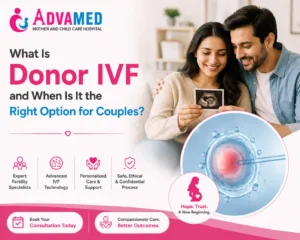


For some couples, the path to parenthood faces a hurdle that cannot be solved with their own eggs. When the ovaries cannot produce healthy eggs, donor IVF opens a door that may otherwise seem closed. Donor egg IVF has helped thousands of women carry and deliver a baby, even when their own eggs are no longer suitable. This blog explains what donor IVF is, who needs it, what success rates to expect, and how to move forward with clarity and confidence.
Understanding Donor IVF in Simple Terms
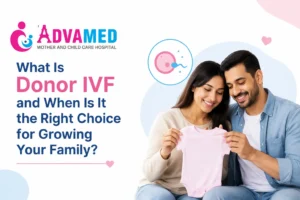
Donor IVF uses eggs from a healthy, screened donor to create embryos for the recipient. The recipient then carries the pregnancy and delivers the baby, making motherhood possible when her own eggs are not viable.
How Donor IVF Differs from Regular IVF
In regular IVF, the woman takes injections to grow her own eggs. Those eggs are retrieved and fertilized with sperm in a laboratory. In donor IVF, the eggs come from a healthy, screened egg donor instead of the woman wishing to conceive. The donor’s eggs are fertilized with the male partner’s sperm or donor sperm. The resulting embryo is then placed gently into the recipient’s uterus. The recipient carries the pregnancy and gives birth. The big difference is the genetic origin of the egg. The child will not share the recipient’s genes, but she will experience pregnancy and delivery just like any other mother.
The Basic Steps of the Process
The first step is selecting an egg donor. Clinics maintain a pool of anonymous donors who are young, healthy, and thoroughly screened. Once the donor is chosen, her cycle and the recipient’s uterine lining are synchronized using hormonal medicines. The donor then undergoes ovarian stimulation and a short egg retrieval procedure. The eggs are fertilized with the partner’s sperm in the IVF lab. One or two good quality embryos are transferred into the recipient’s uterus after a few days of growth. Any extra embryos can be frozen for future use. The recipient takes progesterone and estrogen support to help the embryo implant. A pregnancy test is done about two weeks after the transfer.
Who Should Think About Donor IVF
Donor IVF is recommended for women whose ovaries cannot produce healthy eggs or who have had repeated IVF failures. It provides a realistic path to pregnancy when using one’s own eggs is no longer effective.
Common Medical Reasons
Many women need donor eggs because their ovaries cannot produce eggs at all or cannot produce eggs that lead to a pregnancy. This includes women with premature ovarian failure or early menopause before age forty. Women born without functioning ovaries or those who have had their ovaries surgically removed due to tumours or endometriosis also benefit. Other medical reasons include severe pelvic disease, genetic conditions that a woman does not wish to pass on, or ovaries damaged by chemotherapy or radiation therapy. Women with very low ovarian reserve detected through AMH and antral follicle count may also be advised to consider donor eggs early.
Repeated IVF Failures or Poor Egg Quality
Some women go through multiple IVF cycles using their own eggs but fail to conceive. When embryos repeatedly arrest before day five or are of very poor quality, the main issue often lies in egg quality. This becomes more common as a woman ages. Even a healthy woman over forty-two years old may have a very low chance of success with her own eggs. In such situations, donor eggs can dramatically change the odds. Doctors may recommend donor IVF after two or three failed cycles with poor ovarian response. It is a difficult decision, but it often becomes the most practical way forward when the biological clock is no longer on your side.
Success Rates You Can Expect
Success rates with donor eggs are among the highest in fertility care because donors are young and healthy. Most good centres report clinical pregnancy rates of fifty to sixty percent per embryo transfer.
The IVF with donor eggs success rate is one of the highest among all fertility treatments. Because donors are generally young women under thirty with excellent ovarian health, their eggs have high potential. In a good IVF centre, the clinical pregnancy rate per transfer using donor eggs often ranges from fifty to sixty percent or even higher. Live birth rates also stay strong because young eggs have fewer chromosomal abnormalities. Compared to regular IVF in women over forty, where live birth rates may drop below ten percent, donor eggs offer a reliable path. The recipient’s age matters less for egg quality, but a healthy uterine lining is still important. Success depends on the clinic’s lab quality, the sperm quality, and the recipient’s overall uterine environment. Your fertility specialist can give you a realistic number based on your specific case.
Legal and Ethical Points to Know
Indian guidelines protect both donor and recipient through strict anonymity and health screening. Parents should also be emotionally prepared to raise a child who does not share the mother’s genes.
In India, egg donation is strictly regulated by the Indian Council of Medical Research guidelines. The donor must remain anonymous. As a recipient, you will receive all relevant medical history and physical characteristics of the donor, but you will never know her identity. The donor has no legal rights or responsibilities toward any child born from her eggs. She is screened for infectious and genetic diseases before acceptance. On the ethical side, parents need to be comfortable raising a child who does not share the mother’s genes. Honest counselling is a vital part of the process. Many couples feel some sadness at first, but they often embrace the experience wholeheartedly once they hold their baby. Laws permit donor IVF for married couples, and your clinic will guide you through the documentation needed.
Moving Forward with Confidence
The first step is a detailed consultation to see if donor eggs are the right choice for you. Choosing an experienced centre with clear protocols and emotional support makes the journey smoother.
If you think donor eggs might be your solution, the next step is an open discussion with a fertility specialist. Your doctor will review your history, tests, and past treatments. Choosing a centre with strong experience in donor egg IVF and transparent protocols matters a great deal. If you are searching for an egg donor IVF centre in Chandigarh, you will find that Advamed offers compassionate and affordable donor IVF treatment. We maintain a well-screened donor pool, high lab standards, and guide each couple through every emotional and medical step. Visit Advamed to book your consultation and understand the complete process from start to pregnancy.
FAQs
Yes, carrying the pregnancy, feeling the baby move, and giving birth create a deep biological and emotional connection. The baby grows in your womb, receives your blood supply, and hears your voice. Most mothers say the bond is just as strong as with a genetically related child.
Yes, Indian guidelines require complete donor anonymity. You will receive important details about her health, physical traits, and education, but never her identity. The donor also does not know who receives her eggs.
No, donor eggs come from young, healthy women who undergo thorough medical and genetic screening. This actually lowers the chance of chromosomal problems. The baby is not at higher risk simply because a donor egg was used.
In donor IVF, the donor undergoes stimulation to produce multiple eggs. You will receive one or two high-quality embryos in a transfer, and extra embryos can be frozen. This gives you the option of siblings later without needing another donor cycle.
Simply visit or call the clinic to book a fertility specialist consultation. The team will explain the process, discuss your medical history, and guide you step by step. A supportive counsellor is also available to help you feel ready.